Navajo Bridge

  • Home
  • Historic Sites
  • Navajo Bridge

Navajo Bridge

  • Home
  • Historic Sites
  • Navajo Bridge

Navajo Bridge

Opened in 1929, Navajo Bridge connected northern Arizona and Utah, improving transportation and commerce across the Colorado Plateau. The original bridge remains a historic landmark today.
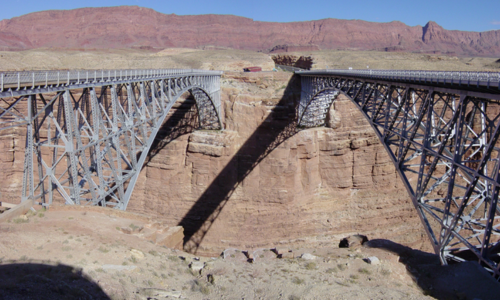
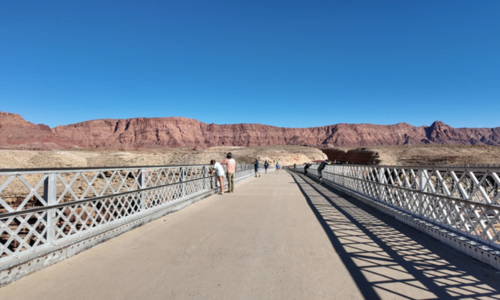
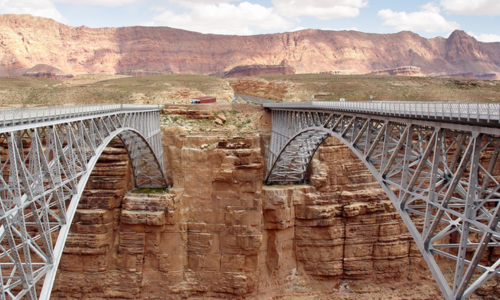
Navajo Bridge is a pair of steel arch bridges spanning the Colorado River in northern Arizona, near Marble Canyon, just downstream from the beginning of the Grand Canyon. One bridge now carries highway traffic, while the older parallel bridge is preserved as a pedestrian-only viewpoint.

Key facts

  • Location: Marble Canyon, northern Arizona, over the Colorado River
  • Function: Road traffic (new bridge) and pedestrian overlook (old bridge)
  • Original bridge opened: 1929
  • Replacement bridge opened: 1995
  • Crossing: Deep canyon at the start of Grand Canyon, connecting US Route 89A

Background and history

Navajo Bridge was built to provide a permanent Colorado River crossing in a very remote part of Arizona, replacing difficult river fords and long detours. The original steel arch bridge opened in 1929 and was then one of the highest bridges in the United States. As vehicle loads increased over the decades, a nearly identical but stronger companion bridge was constructed just downstream and opened in 1995. The historic 1929 structure was kept in place and converted into a pedestrian bridge.

Design and structure

Both bridges are steel two-hinged deck arches, with the roadway carried high above the river. They span the sheer rock walls of Marble Canyon, with the river roughly 470–480 feet below the deck. The designs are visually similar, creating the impression of twin bridges: one for highway traffic and one for foot traffic. Railings, trusses, and arch ribs are exposed, making the structure itself a prominent visual feature.
Visitor experience

The old Navajo Bridge forms the centerpiece of the Navajo Bridge Interpretive Center. Visitors can walk across the span, look straight down to the Colorado River, and get expansive views into Marble Canyon and toward the Grand Canyon. The site is a popular stop along US 89A for sightseeing, photography, and watching rafters far below on the river. Interpretive signs explain the bridge’s history, engineering, and its role in connecting the region.